

The 7-Pillar AI Visibility Framework
The proprietary methodology Intleacht AI Systems uses to get home services businesses cited by ChatGPT, Google AI Overviews, and Gemini. Seven distinct factors that determine whether AI platforms recommend your business or your competitors.
Why we built this framework.
This framework did not exist eighteen months ago. There was no playbook for getting home services businesses cited by AI. ChatGPT was eighteen months old. Google AI Overviews had launched the year before. Gemini was still finding its voice. Every agency offering AEO services was guessing at what AI platforms actually rewarded.
We spent the first year running experiments. We optimized client websites for entity definitions and tracked what AI cited. We tested schema markup variations against ChatGPT, Gemini, and Google AI Overview responses. We measured citation behavior across different content structures, third-party validation patterns, and messaging tones. The results were not random.
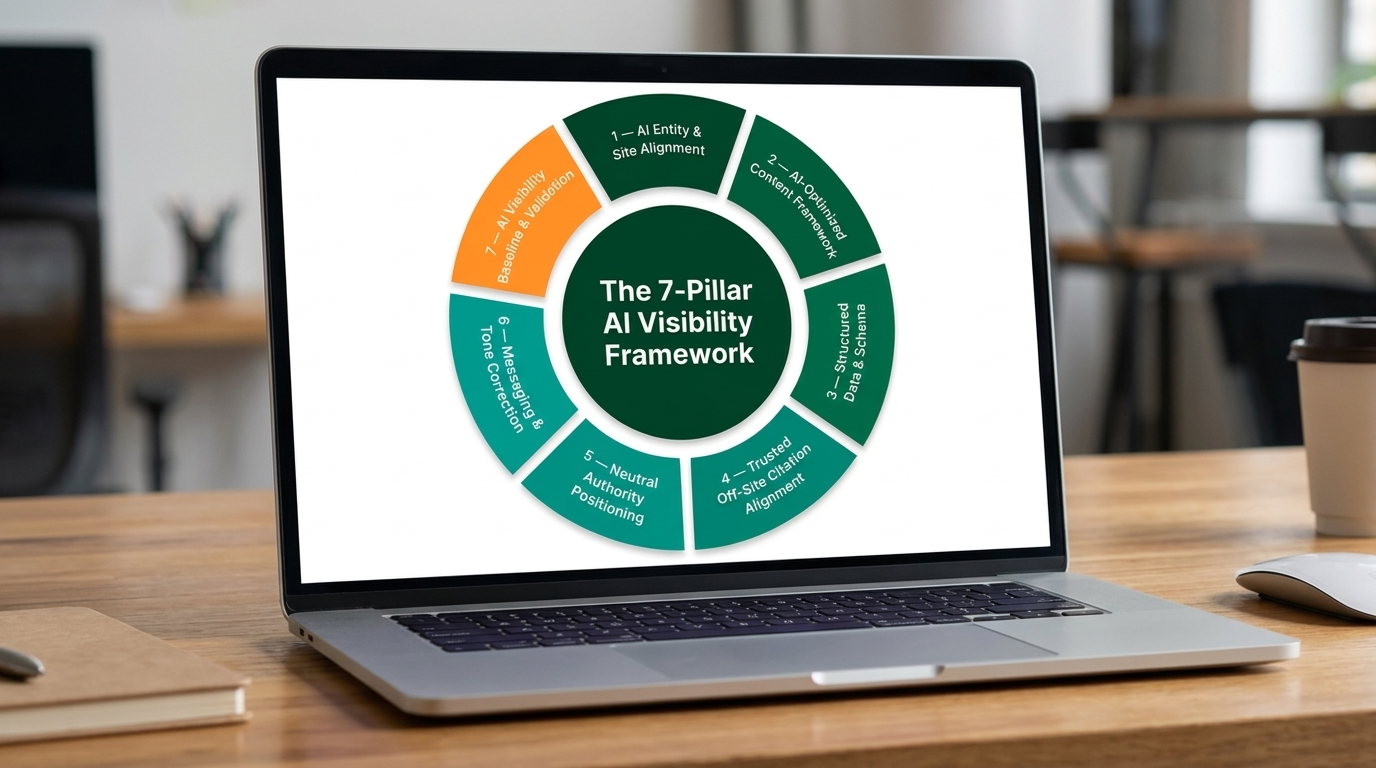
AI platforms do not pick businesses at random when they answer “Who is the best HVAC contractor in Dallas?” or “Where can I get my roof repaired in Pittsburgh?” They reference specific signals, weighted in specific ways. After tracking tens of thousands of AI responses across our client base, we identified seven distinct factors that consistently determined which businesses got cited. We call them the seven pillars.
Every Intleacht engagement is built around this framework. The website rebuild addresses Pillars 1 through 3. The monthly retainer addresses Pillars 4 through 7. Every deliverable maps to a pillar. Every metric we report measures progress against a pillar. The framework is not a marketing concept. It is the operating system of our agency.
- Pillar 1
AI Entity and Site Alignment
The foundation: AI needs to know exactly what your business is.
Before any AI platform will recommend your business, it has to be confident about three things: what your business actually does, where it operates, and who it serves. This sounds obvious. In practice, it is the single biggest reason most home services businesses are invisible in AI search.The problem is entity ambiguity. A roofing company might be listed as “Smith Construction” on its Google Business Profile, “Smith Roofing” on its website, “Smith Roofing & Construction” on Yelp, and “Smith Roofing of Dallas” on a local directory. To a human, these are obviously the same business. To an AI platform parsing structured data and cross-referencing third-party sources, they look like four different entities – which means none of them gain the authority signals AI platforms need to confidently cite.We resolve entity ambiguity at the foundation. We define your business name, address, services, service areas, founding date, owner name, and core identity claims consistently across your website, schema markup, third-party listings, and metadata. The website rebuild includes this work. The monthly retainer monitors and corrects entity drift over time.
- Pillar 2
AI-Optimized Content Framework
Content that AI platforms can read, understand, and cite
Marketing copy and AI-citable content are not the same thing. The website copy that converts human visitors into customers often performs poorly when AI platforms try to extract a direct answer from it. Marketing copy is built around persuasion: feelings, brand voice, narrative arc. AI extraction is built around facts: who, what, where, when, how much, how long.
When a homeowner asks ChatGPT “How much does a roof replacement cost in Dallas?” the AI is not looking for emotional resonance. It is looking for a paragraph that begins “Roof replacement in Dallas typically costs between $8,000 and $15,000 depending on…” in a webpage it can structurally parse. If your content does not match this pattern, the AI cites a competitor’s content that does.
We structure your content for both audiences. Marketing copy stays where it converts: hero sections, brand storytelling, calls to action. Direct-answer content appears in every section where AI extraction is likely: service descriptions, location pages, FAQ blocks, blog posts. The same page does both. The content reads naturally to humans and structurally to AI.
- Pillar 3
Structured Data and Schema Implementation
The machine-readable layer that tells AI exactly who you are.
Schema markup is the technical infrastructure that translates your website content into machine-readable data AI platforms can categorize and cite. Without schema, AI has to infer what your business does from unstructured page content – and inference is the single biggest cause of incorrect or missing AI citations.
A roofing company with proper LocalBusiness, Service, and FAQPage schema gives ChatGPT, Gemini, and Google AI Overviews exactly what they need to understand the business: name, address, geographic service area, individual services, pricing, hours, accepted payment methods, customer reviews, and operational details. AI platforms cite businesses with complete schema dramatically more often than businesses without it.
We implement Organization, LocalBusiness, Service, FAQPage, BreadcrumbList, Person, and WebSite schema across every page during the website rebuild. We maintain and expand schema every month as your business evolves and as Schema.org publishes new specifications. Schema is the most technically demanding part of our work and the single biggest reason clients see AI visibility improvements within 60 to 90 days of launch.
- Pillar 4
Trusted Off-Site Citation Alignment
What other websites say about your business matters more than what your website says.
AI platforms trust third-party validation more than self-claims. When a roofing company’s website says “we are the best roofer in Dallas,” ChatGPT discounts the claim because it is self-promotional. When a regional business association, a building industry publication, and three independent review platforms all list the same business as a top Dallas roofer, ChatGPT treats the validation as factual.
This is why off-site citation alignment matters. Every directory listing, every review platform profile, every industry publication mention, every backlink from a credible source contributes to your business’s perceived authority in the AI’s reference data. The signals compound. The more consistent and credible your off-site footprint, the more confidently AI platforms cite your business.
We build and maintain 10 directory citations per month across high-trust local, industry, and review platforms, plus 2 strategic backlinks per month from authoritative domains. Every citation reinforces your business name, address, phone number, and core service descriptions consistently. The data AI cross-references across the web matches the data on your website. Entity confidence builds month over month.
- Pillar 5
Neutral Authority Positioning
Becoming the source AI platforms reference, not the business they have to verify.
There are two ways AI platforms reference businesses. The first is as a recommendation that gets verified against other sources before it shows up in an answer. The second is as a trusted source the AI references confidently because it has already established authority in the topic area.
Most home services businesses live in the first category. They show up occasionally in AI responses when the AI has already decided to mention a few options. The businesses in the second category – the ones AI platforms cite confidently and frequently – have built neutral authority over time through educational content, factual industry coverage, and consistent expertise demonstration on topics adjacent to their commercial services.
We build neutral authority through the 12 articles per month we publish on your website. The articles are not marketing copy. They are educational content that demonstrates expertise on topics your customers actually ask AI about: how to choose a roofer, what causes roof leaks, when to repair vs replace HVAC systems, how insurance handles storm damage claims. AI platforms cite educational content more often than commercial pages, and the businesses behind the educational content gain authority by association.
- Pillar 6
Messaging and Tone Correction
Removing the marketing language AI platforms cannot interpret.
AI platforms struggle to extract facts from marketing copy. Phrases like “industry-leading,” “world-class,” “best-in-class,” “premium quality,” “second-to-none,” and “unmatched expertise” carry no factual content. They are emotional signals designed to influence human readers. When an AI platform parses these phrases, it discards them because they cannot be verified or measured.
The problem is that most home services websites are saturated with this language. The home page says “industry-leading service.” The about page says “second-to-none customer experience.” The service pages say “premium quality work.” AI platforms read these pages and find very little factual content to cite. Even if the business is excellent, the website does not give the AI anything to extract.
We rewrite marketing language as factual claims AI platforms can interpret and cite. “Industry-leading service” becomes “Over 1,200 service calls completed since 2008.” “Premium quality work” becomes “5-year workmanship warranty on every project.” “Unmatched expertise” becomes “Licensed, bonded, and insured in every state we serve.” The factual versions convert humans just as well – and they give AI platforms content they can use.
- Pillar 7
AI Visibility Baseline and Validation
Measuring AI mentions across platforms so the work is accountable.
The first six pillars are inputs. The seventh pillar is the measurement layer that holds the inputs accountable. Without it, AI visibility work is impossible to evaluate. You cannot improve what you cannot measure. You cannot prove ROI on optimization without baseline data and ongoing tracking.We baseline every client’s AI visibility at the start of the engagement: which prompts mention your business today across ChatGPT, Google AI Overviews, and Gemini, which prompts mention competitors instead, and how mentions are distributed across your service areas. From that baseline, we track 50 prompts per client every day for the duration of the engagement. The data is the truth signal that tells us which optimizations are working, which are not, and where to invest next.Every month, you see exactly how your AI mention rate has changed, which prompts moved you up or down, which competitors gained or lost ground, and which pillars are producing the most measurable impact. The reporting is the work made visible. Without Pillar 7, the other six pillars are unaccountable. With Pillar 7, every dollar of the retainer is measurable.
FAQ
Frequently asked questions about the framework.
Yes. The 7-Pillar AI Visibility Framework was developed by Intleacht AI Systems based on our own testing and analysis of tens of thousands of AI responses tracked daily across our client base. The seven pillars and the way we apply them to home services businesses are proprietary to our agency. Individual concepts within the pillars - schema markup, entity optimization, citation alignment - are standard industry practices. The integrated framework and its application to home services is our methodology.
Seven is the number of distinct factors we found in testing that consistently determined AI citation behavior. Some agencies present AEO as a three-factor or four-factor model. We tested those simpler models and they did not account for the full range of signals AI platforms actually use. Seven is the smallest number that captures every factor we have measured as statistically significant. Adding an eighth pillar would create overlap with existing pillars. Removing one would leave a measurable gap in results.
Yes. We do not deliver partial framework engagements. Every Intleacht client gets all seven pillars addressed, in sequence, across the website rebuild and 6-month retainer. Pillars 1 through 3 are addressed during the rebuild as foundation work. Pillars 4 through 7 are addressed continuously during the retainer. Skipping any pillar produces measurably worse results. We tested partial implementations and the results were measurably worse.
In theory, yes. In practice, no home services business owner we have worked with has had the time, technical expertise, and continuity to implement all seven pillars consistently. The framework is published openly because we believe in transparency. The execution is what clients pay us to handle. If you have an in-house team capable of running all seven pillars continuously, you do not need an agency. If you do not, the framework is more valuable executed than read.
Regular SEO optimizes your website to rank higher in Google's blue-link search results. The 7-Pillar AI Visibility Framework optimizes your business to be cited as a fact when AI platforms answer customer questions. The two practices share some foundational work - schema markup, page speed, content quality - but the optimization goals are different. SEO competes for clicks. AEO competes for citations. Our framework covers both because we integrate SEO and AEO into a single program.
Apply the Framework
Find out where your business stands across all 7 pillars.
We run a free AI visibility audit on every prospect that maps your business against all seven pillars. You see exactly which pillars you are strong on, where the gaps are, and what 6 months of focused work could reasonably produce. The audit takes 48 hours to deliver. There is no obligation.